The Crown

The merchant claimed the hand had belonged to a baron.
It was solid gold, broken cleanly at the wrist, and so perfectly formed that every crease remained upon its palm. Even the faint impression of a signet ring encircled one finger, though the ring itself was gone.
King Mavren purchased it before the merchant could finish naming his price.
He carried the hand through the palace himself, cradling it against his chest. His ministers followed at a respectful distance, whispering about its workmanship.
“It was never fashioned,” said the oldest among them. “Look at the nails. Look at the veins. Something made this.”
“Yes,” Mavren replied. “Fortune.”
He summoned the royal goldsmith and ordered the hand melted into a crown.
The goldsmith examined it for a long while.
“Majesty,” she said, “gold remembers.”
“Gold remembers its owner,” said the king. “And I am its owner now.”
The hand was placed within the furnace.
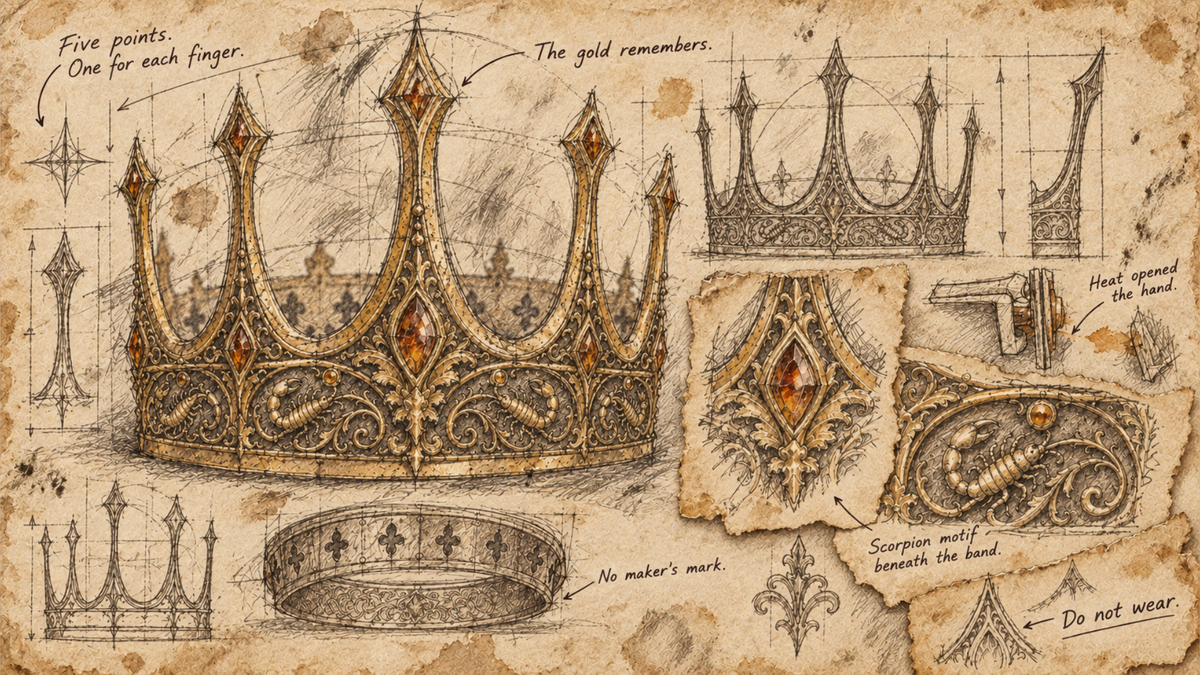
As the flames rose, its fingers slowly opened.
The goldsmith told herself it was the heat.
When the crown was finished, it bore five slender points. No ornament had been added, yet the gold possessed a warmth and brilliance unlike anything within the royal treasury.
Mavren placed it upon his head and smiled.
Thereafter, he wore it everywhere.
At council.
At supper.
While hunting.
Even while asleep.
At first, the people praised its beauty. Mavren rewarded those who praised it most lavishly, and soon the palace rang with declarations that no king had ever possessed so magnificent a crown.
But admiration is a troublesome thing.
The king began to notice how long certain men looked at it.
He saw a servant staring at its reflection in a silver tray and had every polished tray removed from the palace. When his cousin complimented the crown twice in one evening, Mavren stripped him of his lands. When the queen suggested he remove it before bed, he banished her to a distant estate.
“You would like to know where I keep it,” he told her.
No one in the palace was permitted to wear gold. Then yellow cloth was forbidden. Brass buckles were seized. Coins were carried in blackened purses so their gleam could not offend the king.
Still, Mavren saw hunger in every eye.
He ordered his throne raised so no one might stand level with the crown. He commanded petitioners to approach him with their heads bowed. When they obeyed, he accused them of watching its reflection upon the floor.
The goldsmith was dragged before him in chains.
“You kept some,” said Mavren.
“Kept what, Majesty?”
“A piece of the hand.”
“Every grain went into the crown.”
“A crown should have no equal.”
“It has none.”
The answer pleased him.
The fear in her voice did not.
By the following morning, the royal goldsmith had disappeared.
Mavren trusted no one after that. He dismissed his guards, poisoned his hounds, and sealed the treasury beneath stone. Yet each night he awoke clutching the crown, certain he had heard footsteps retreating from his chamber.
At last, he decided that an entire kingdom coveted what was his.
So the king fled.
He wrapped the crown in a rag, slipped through a forgotten gate, and wandered into the desert alone. He walked until the palace vanished, then until the road vanished, and finally until there was nothing around him but wind and sand.
There, beneath a white and merciless sun, King Mavren found the scorpions.
They emerged from cracks in the rocks and gathered within his shadow.
The king laughed.
Scorpions possessed no courts. They commanded no armies. They had no use for thrones, titles, or crowns.
“Here,” Mavren whispered, placing the crown once more upon his head, “I am finally among creatures who do not desire what is mine.”
The scorpions climbed into his robes.
Their pincers rose before him.
Mavren mistook this for worship.
He bowed to receive it.
Blink closed the book.
“And that,” he said, “is the last known whereabouts of the crown.”
Candlelight shifted across his study as he slid a folded piece of parchment across the desk.
“A benefactor is willing to pay handsomely to have it found.“
The Shagal picked up the parchment but did not open it.
“Has he paid the usual half?”
Blink winked.
“You have a long journey ahead of you,” he said. “Pack well.”