The Thread
No blade can sever it. No flame can blacken it. A village shroudmaker believes the white thread belongs with the dead. But some things have farther to travel than anyone imagines.

I. The Shroud
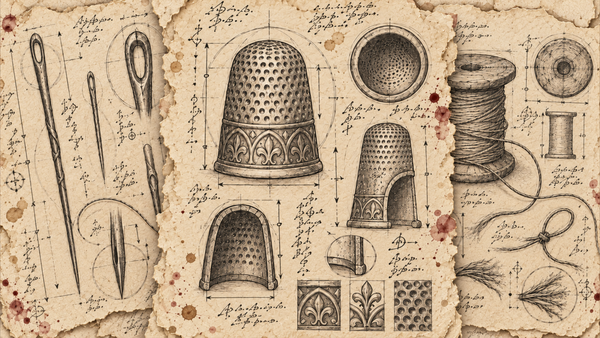
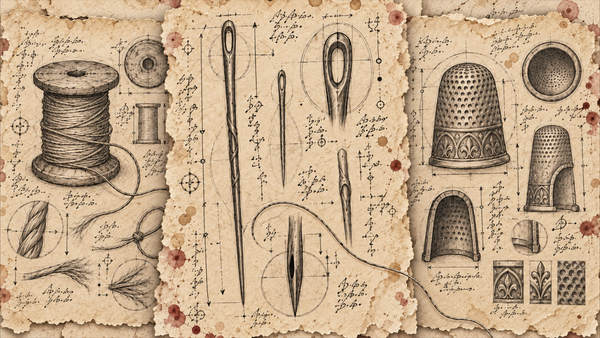
When the needle was found, a single white thread still hung from its eye.
The village shroudmaker wanted nothing to do with the needle, but she drew the thread free and carried it home. No blade could cut it. No flame could blacken it. Even when she wound it around both hands and pulled, it would not break.
She decided that something so enduring belonged with the dead.
That winter, a young mother died during the first snow. The shroudmaker wrapped her in white wool, sewing every fold with the unbreakable thread.
The woman’s son stood beside the bier in a summer cloak he had nearly outgrown. His bare wrists had turned purple from the cold.
“Will my mother be cold beneath the ground?” he asked.
“No,” said the shroudmaker.
“Then why must she take the warmest cloth?”
The question followed the shroudmaker home.
Before sunrise, she returned to the burial house. Because the thread could not be severed, she patiently drew it backward through every seam. She folded the wool to the child’s measure and stitched the same thread forward again.
At the burial, the boy appeared in a new white cloak.
“That is his mother’s shroud,” someone whispered.
“Yes,” said the shroudmaker, fastening it beneath his chin. “Let it do a mother’s work.”
The woman entered the earth wrapped in common linen.
Her shroud walked home upon her son’s shoulders.
II. The Cloak
At first, the white cloak reached Tavin’s boots.
Then it reached his calves.
Then his knees.
Each spring, the shroudmaker opened the seams and let out whatever cloth remained. When there was no more to release, she added patches: brown wool from a grain sack, blue cloth from an old banner, green felt from a winter cap.
The white thread passed through them all.
By the time Tavin became a man, the cloak barely reached his waist. He folded it carefully and placed it inside a cedar chest.
Many years later, a halfling traveler arrived at his door during a rainstorm. The river had swallowed the traveler’s pack, his provisions, and the traveling coat his wife had made for him.
Tavin remembered the little white cloak.
On the halfling, it fell nearly to his ankles.
“It appears to have been waiting for you,” Tavin said.
The halfling would not accept it as a gift. Instead, he offered Tavin a small copper bell.
“It rings whenever there is a welcoming hearth nearby,” he explained. “But it remains silent outside the homes of those who would turn you away.”
“That is worth far more than an old cloak.”
“Not on a wet night.”
So they traded.
That evening, the copper bell rang before Tavin had traveled half a mile. At the next cottage, an old woman had already placed a second bowl beside her fire.
The halfling continued down the road beneath the patchwork cloak.
Both men believed they had received the better bargain.
III. The Gown
By the time the halfling reached the lands of the Elves, none of the original shroud remained.
The white wool had been replaced piece by piece: red cloth from a festival tent, grey wool from a shepherd, yellow linen from a sail that had crossed the Inland Sea. Only the thread remained unchanged, holding together every place the cloak had traveled.
An Elven weaver noticed it in the market.
“What would you accept for that garment?” she asked.
The halfling laughed. “It would scarcely cover your shoulders.”
“Not in its present form.”
She offered him a traveling mantle woven from rainleaf—soft as moss, green as spring, and dry even beneath a waterfall.
The halfling considered the mantle, then the old cloak.
“A fair trade,” he decided, “provided you promise not to bury it.”
The Elven weaver did not understand, but she promised.
For seven days, she unpicked the cloak. As the white thread passed through her fingers, she felt things it could not have known: the stillness of a burial house, the warmth of a child’s shoulders, the rhythm of small feet upon a very long road.
No Elf in her house could name the magic that had made it.
The weaver threaded it through silver-blue cloth and fashioned a naming gown for her newborn daughter.
Beneath the two Harrow Moons, the child was presented to her people. The white thread shimmered throughout the gown, briefly tracing the shapes it had once held: a burial shroud, a little cloak, and a halfling’s traveling coat.
“Why use such an old thread for her first garment?” someone asked.
The weaver gathered her daughter into her arms.
“Because it already knows how to carry someone home.”
Once, the thread had been sewn for someone leaving the world.
Now it was worn by someone entering it.